Volume of a Rectangular Pyramid: Formula and Examples
Find the volume of a rectangular pyramid using V = lwh ÷ 3. Learn which height to measure, why the formula divides by three, and how to reverse it.
TL;DR
The volume of a rectangular pyramid is one third of its base area times its perpendicular height. If you only know a slant height, find the perpendicular height before substituting.
Key Points
- The volume of a rectangular pyramid equals one third of the product of its base length, base width, and perpendicular height.
- An oblique pyramid and a right pyramid have equal volumes whenever their rectangular bases have equal areas and their perpendicular heights match.
- A centred pyramid with a non-square base has two different face slant heights, so the labelled edge determines which half-width to use.
- A slice halfway from the base to the apex has one quarter of the base area because both its length and width are halved.
What is the volume of a rectangular pyramid?
The volume of a rectangular pyramid measures the space inside a solid with a rectangular base and four triangular faces that meet at one apex. A matching box fills its full height with the same rectangle. The pyramid starts with that rectangle and tapers to a point.
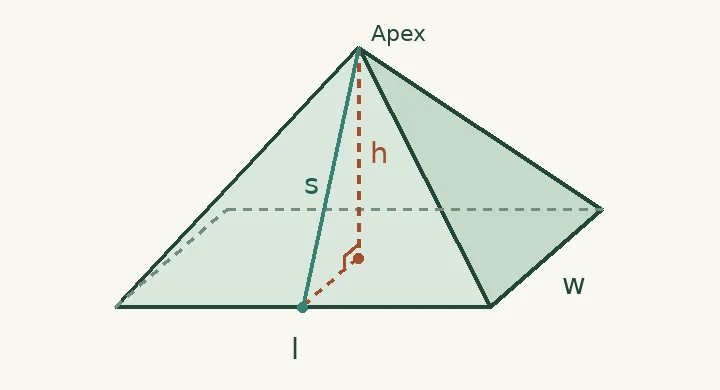
The Papua New Guinea Department of Education distinguishes a right pyramid, whose apex lies directly above the centre of the base, from an oblique pyramid, whose apex sits off-centre. In either case, the solid has five faces, eight edges, and five vertices. A net of the pyramid opens out into one rectangle and four attached triangles.
How do you find the volume of a rectangular pyramid?
Find the area of the base, multiply it by the perpendicular height, and divide the result by three. The volume rule uses the same base-area–height product as a rectangular prism, with a factor that accounts for the taper.
| Symbol | What to measure |
|---|---|
| Length of one side of the rectangular base | |
| Length of the adjacent side of the rectangular base | |
| Base area, in square units | |
| Shortest distance from the apex to the plane containing the base | |
| Volume, in cubic units |
Use one length unit for , , and . If the base area already appears in the question, use it as . Neither the perimeter of the base nor the areas of the four side faces belong in the volume formula.
How do you find height from volume?
Reverse the multiplication by and the division by three. For a positive base area, the result is . If the answer gives a length in square or cubic units, check that you divided cubic units by square units.
Why does the formula divide by three?
A cube can be split into three equal-volume pyramids. Pick a corner as the common apex. Each pyramid uses one of the three cube faces that do not touch that corner as its base. The three regions fill the cube, meeting along their boundaries, and swapping the cube’s coordinate directions shows that they have equal volume.
Stretch that cube independently along its length, width, and height. Each of its three regions scales by the same factor, so the resulting corner-based pyramid still occupies one third of the box. The height of that pyramid equals the dimension perpendicular to its base.
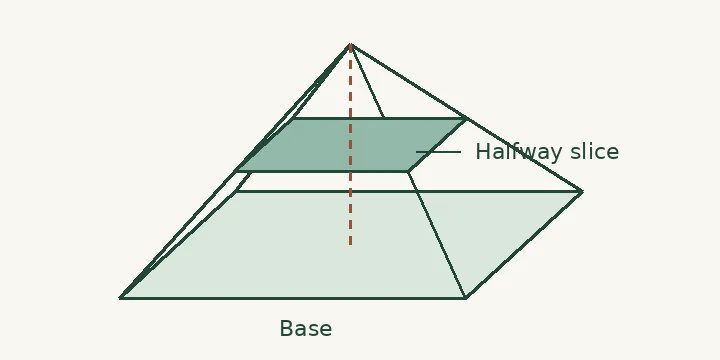
Brown University’s Volume Patterns for Pyramids and the Australian Mathematical Sciences Institute explain how cross-sections extend the result to other apex positions. At a distance down from the apex, measured perpendicularly, the parallel slice has length and width . Its area is . Moving the apex sideways moves each slice sideways while preserving its area. Cavalieri’s principle says the volume stays the same, which explains why the formula also works for centred and oblique pyramids.
If you are learning integration, OpenStax’s slicing method gives the same factor directly.
Which height do you use if a diagram gives a slant height?
Use the height that meets the base plane at a right angle. A face slant height lies on a triangular face. A slanted edge runs to a corner of the base. Each of these lengths follows a different path from the apex.
For a right rectangular pyramid, the apex sits over the base centre. Let be the slant height measured to the midpoint of a side of length . The horizontal run from the centre to that midpoint is . Apply the Pythagorean theorem to that cross-section.
A slant height measured to a side of length uses instead. For an oblique pyramid, identify the actual horizontal distance from the foot of the perpendicular to the point where the slant segment meets the base. Monash University’s square-based example shows how the face slant height and perpendicular height meet in such a right triangle.
Where do slant heights belong in surface area?
Surface area measures the faces you could cover, in square units. The two faces along the length have area each, while the two along the width have area each in a right rectangular pyramid. Here denotes the face slant height to the midpoint of a width edge.
For an oblique pyramid, find the altitude of each triangular face separately. Use the base and four face areas to find total surface area.
Examples of Volume of a Rectangular Pyramid
Use the examples to practise selecting the height, using a supplied base area, reversing the formula and handling mixed length units.
Example 1
Find the volume for a base 9 cm long and 5 cm wide and a perpendicular height of 8 cm.
- Find the base area, .
- Multiply by the perpendicular height, .
- Divide by three to get .
Example 2
A right pyramid has a 10 cm by 24 cm base. A 13 cm face slant height meets the midpoint of a 10 cm edge. Find the volume.
- Using 13 cm directly gives . That would require a perpendicular height of 13 cm, even though the 13 cm segment travels sideways as well as vertically.
- The run across the base is half of 24 cm, or 12 cm. Use .
- Substitute the perpendicular height to get .
Example 3
An oblique rectangular pyramid has base area 12 m² and perpendicular height 5.25 m. Find its volume.
- Use the supplied base area as . The horizontal position of the apex does not change this input or the height.
- Compute .
- Divide the product by three to get .
Example 4
A rectangular pyramid holds 126 cm³. Its base measures 7.5 cm by 6 cm. Find the perpendicular height.
- Find the base area, .
- Multiply the volume by three to recover the matching box volume, .
- Divide by the base area, .
Example 5
A model hopper narrows to a point. Its opening is 1.2 m by 0.75 m, and its perpendicular depth is 45 cm. Find its capacity in litres.
- Express the depth in metres, .
- Find the volume, .
- NIST’s SI volume table gives 1000 litres per cubic metre, so the capacity is litres. A real hopper that stops at a smaller rectangular outlet needs a truncated-pyramid calculation.
Example 6
A room measures 8 m by 6 m. Its walls are 3 m tall and a pyramid roof rises another 2.5 m. Find the air space under the roof and above the floor, ignoring wall thickness.
- The shared base area is .
- The room’s box-shaped part holds .
- Using the rise from the top of the walls, the roof holds .
- Add the disjoint parts to get .
Where can a correct calculation use the wrong measurements?
The quickest check is to label the two dimensions that lie in the base, then draw the altitude on a new sketch. A neat calculation can still use the wrong height or units.
Mistake 1. Measuring all the way to the floor
Where it slips in
A roof problem may give a peak elevation above the floor while the pyramid begins at the tops of the walls.
The tempting calculation
A peak at 7 m over walls 4 m tall can lead to a roof height of 7 m when you go straight from the diagram to the volume formula.
The correction
Measure the difference between the peak and the base of the roof. In that drawing the roof height is m.
Mistake 2. Converting the finished volume as a length
Where it slips in
Seeing centimetres and metres in the same question can make a familiar factor of 100 feel sufficient for the final conversion.
The tempting calculation
Dividing a value in cubic centimetres by 100 updates only one dimension.
The correction
Convert each input to metres before finding the volume, or divide a cubic-centimetre result by .
Practice with answers
- A pyramid has a base 14 cm by 9 cm and a perpendicular height of 5 cm. Find its volume.
- A right rectangular pyramid has a square base with side 16 m. The face slant height is 17 m. Find the perpendicular height and volume.
- Keep the base length and height fixed and double the width. Predict how the volume changes.
Check your solutions
- The base area is . Multiplying by 5 cm and dividing by three gives .
- The horizontal run is 8 m, so . The volume is .
- The base area doubles. The height and the factor stay fixed, so the volume doubles.
Frequently Asked Questions
What units do you use for the volume of a rectangular pyramid?
Use cubic units. Three lengths in centimetres give a volume in cubic centimetres.
Can you calculate the volume of a rectangular pyramid if you know only its slant height?
A slant height alone is insufficient. For a right rectangular pyramid with known base dimensions, identify the face the measurement belongs to and use its horizontal run to recover the perpendicular height.
Does a square pyramid need a different volume formula?
The same rule applies. If each base edge has length , substitute to get .
Does a pyramid with its apex outside the rectangle still use the same volume rule?
Yes. Extend the base to its plane and measure the perpendicular distance to that plane. Shifting the apex sideways preserves the areas of the parallel slices.
What to Remember About Pyramid Volume
- The volume of a rectangular pyramid is one third of the volume of a prism with the same base area and perpendicular height.
- Trace a face slant height to its base edge before choosing the horizontal leg of the right triangle.
- Match length units before multiplying and report the result in cubic units.
Read More
Research Behind This Article
- Papua New Guinea Department of Education, Grade 9 Mathematics, Unit 5, Topic 4, Lesson 17. FODE learning module.
- Thomas F. Banchoff, Brown University, Volume Patterns for Pyramids. Brown University.
- Australian Mathematical Sciences Institute, Cones, Pyramids and Spheres. AMSI Teaching Modules.
- OpenStax, Calculus Volume 2, Determining Volumes by Slicing. OpenStax.
- Monash University, Surface Area and Volume. Student Academic Success.
- National Institute of Standards and Technology, SI Units – Volume. NIST.